Wellsense VŪ visualizes patient pressure in real time, enabling nurses to effectively offload pressure and confirm the result before leaving the bedside.
Schedule a call
Pressure is invisible, so every turn is a best guess.
Pressure often remains high after the turn.
When an injury happens, the nurse takes the blame - with no record of what the pressure was.

Every patient turned by experienced nurses had areas of perisacral skin above elevated pressure thresholds more than 95% of the time.

Peterson et al., J Rehabil Res Dev 2013 · View the study
VGPO is a procedure the nurse performs at every turn. The nurse sees the patient's pressure on the display, turns/repositions the patient to offload it, and confirms
that the measured pressure was offloaded before leaving the bedside.


The display shows the patient's pressure, live.
The nurse turns/repositions using what the display shows. Sometimes a small shift or a pillow is enough.
The nurse confirms that the measured pressure was offloaded before leaving the bedside.
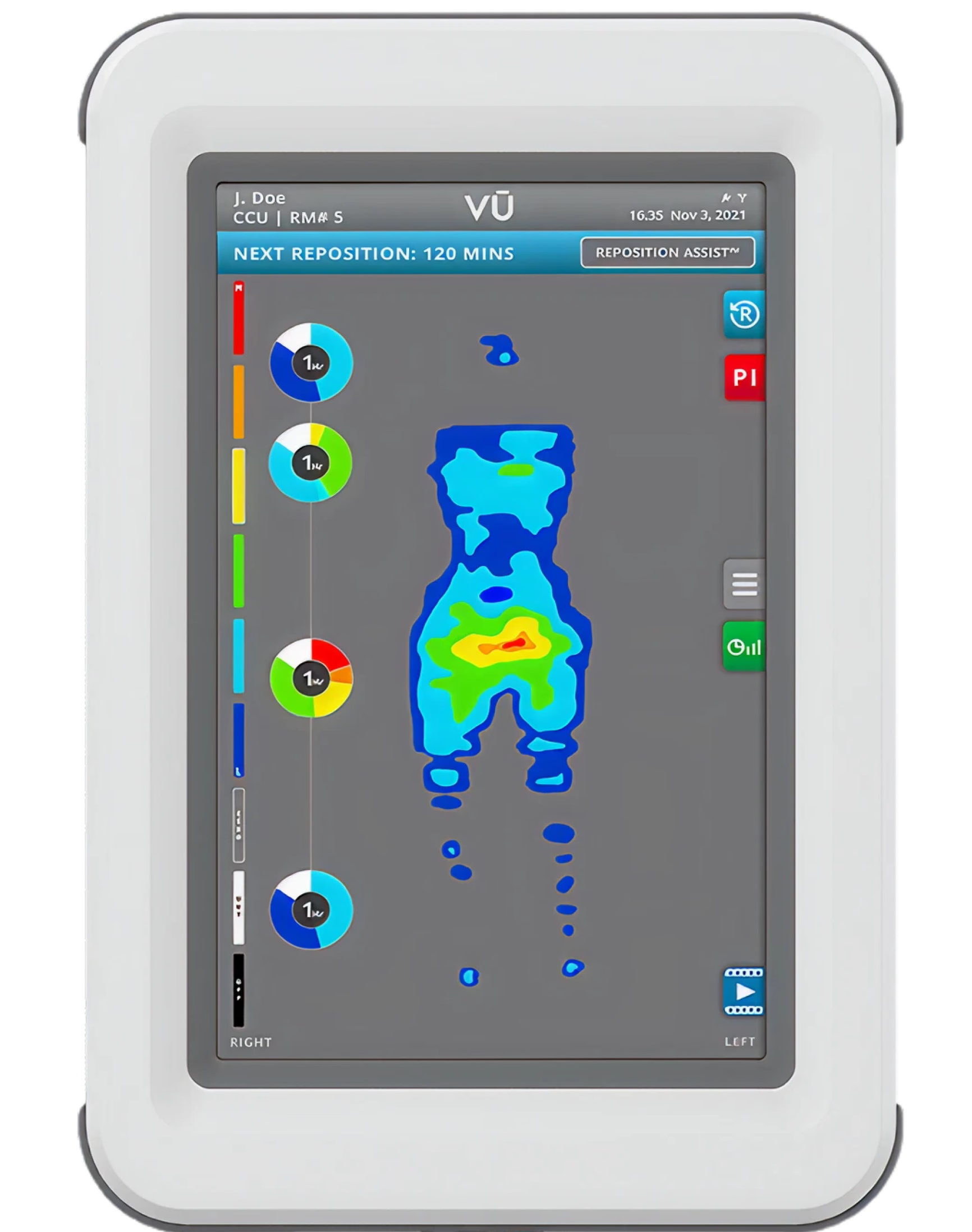
No guessing, no blind turning.
Peer-reviewed studies in U.S. hospitals report fewer hospital-acquired pressure injuries after nurses adopted VGPO.
View the clinical libraryAn independent systematic review and meta-analysis, published in Advances in Skin & Wound Care.
View the articleA major academic burn unit, in patients with severely compromised skin and limited mobility.
View the posterIn use in critical care units across the country.
Hospitals will be accountable for the majority of their pressure injuries - not just the most severe ones.
Share of hospital-acquired pressure injuries reportable today (Stage 3, Stage 4 and unstageable)
Share reportable from 2028, once Stage 2 and deep tissue injuries are added
Increase in reportable pressure injury events (derived: 83.2% vs 21.5%)
Stage 2 and deep tissue injuries are the two largest groups of pressure injuries in acute care. View the study
A short call with a clinical specialist, no obligation. CapEx-free, so no capital purchase is needed to start.
Wellsense, Inc. (“Wellsense”) is committed to protecting and respecting your privacy and safeguarding any personal data that you give to us. We are transparent about the limited personal data we collect, why we collect it and how it is managed and shared. By submitting your personal data to Wellsense, and by using the Wellsense website, you agree to the terms of this Privacy Policy. You can contact Wellsense at:
Wellsense, Inc.
123 Brown Street
Birmingham, Michigan 48009
Phone +1 888 335-0995
Email: privacy@wellsensevu.com
Wellsense collects basic contact information, including name, email address, phone number, company name and zip code.
Wellsense uses your data to:
When you provide your personal data to Wellsense you consent to the collection, use, processing, transfer, and disclosure of your personal and non-personal data, globally, in accordance with this Privacy Policy. Your information, whether public or private, will not be sold, exchanged, transferred, or given to any other company for any reason whatsoever, without your consent, other than for the purposes stated in our Privacy Policy.
You may withdraw your consent by sending a request for deletion of your personal data to privacy@wellsensevu.com.
Your information is only shared to the extent necessary to fulfil our business obligations, to accomplish one of the lawful purposes described in this Privacy Policy, or in response to your express instructions.
Information provided to Wellsense may be accessible to Wellsense personnel, Wellsense related entities and Wellsense vendors. Any third party with whom we share user data, including any parent, subsidiary, or other related entities, will provide the same or equal protection of user data as stated in this Policy.
Beyond this, Wellsense will disclose personal data, without notice, only in limited circumstances, when necessary to: (a) conform to the edicts of the law or comply with legal process served on Wellsense, its affiliates or the site; (b) protect and defend the rights or property of Wellsense, its affiliates or this site; or (c) act under exigent circumstances to protect the personal safety of Wellsense or affiliate personnel, users of their websites, or the public; or (2) if required to do so by law.
The Wellsense website is hosted in the United States. If you are accessing this website from the European Union or any other region, please be advised that through your use of this website, your personal data might be transferred to the United States. The USA is a non-adequate country for data transfer as determined by the UK government.
We will process your data for as long as you consent to share it with us.
You may correct or update personal data, request a copy or your information, make updates or request restriction or deletion of their personal information by submitting a request to the Wellsense at privacy@wellsensevu.com.
Wellsense intends to retain personal data only so long as necessary to carry out the Wellsense’s business activities and comply with its legal obligations. If you wish to have your personal data deleted, notify Wellsense at privacy@wellsensevu.com
If you are in the European Union and wish to raise a concern about the processing of your information, you have the right to lodge a complaint with a supervisory authority pursuant to the EU General Data Protection Regulation.
To protect your personal data, the Wellsense maintains reasonable administrative, technical, and physical safeguards. Unfortunately, despite such measures, no data transmission over the Internet and no database or other depository of information can be one hundred percent secure. As a result, while we will strive to protect your personal data, we cannot and do not guarantee or warrant the security of any of your personal data. We will not be and are not liable for disclosures of your personal information due to errors in transmission, networks that we do not control, or unauthorized acts of third parties.
You have rights in respect of our processing of your personal data which are:
If you want to exercise any of these rights, please contact us via email at privacy@wellsensevu.com.
We may collect non-personal data on an individual and aggregate basis that includes all site visitors. This data may be used to Compile aggregate and statistical data to improve our website and the user experience and perform analytics on the user’s experience while visiting this site on an aggregate level that does not identify you or your information personally. This collection may involve the use of a third-party vendor acting on behalf of Wellsense. Wellsense’s vendors have entered into contracts to perform site analytics and are provided aggregate information only to perform those services. They may not share or resell the information
To enhance the performnce and functionality of our website, we may use “cookies” (small text files with configuration information) to determine how often our website is used and the number of users visiting our website. None of the anonymously collected usage data is combined with your personal data
Most browsers are preset so that cookies are accepted automatically. However, you do have the option to deactivate cookies or to set your browser so that you are notified before cookies are stored. You can adjust your preferences at any time. In some cases, users who do not accept cookies may not be able to access certain areas of our website.
We may use third-party click tracking analytics tools (such as DART, Omniture tags, DoubleClick, Efficient Frontier, and Google Analytics) to capture clickthrough statistics.
When you visit our website, the server housing the pages automatically generates a “session log.” We use session logs to help us determine how people travel through our site. In this way, we can structure our pages so that the information most frequently visited is easier to find. By tracking page visits, we can also determine if the information we’re providing is being used. The only data gathered is the Internet Protocol (IP) address from which you came, the website that referred you, the pages you visited and the date and time of those visits.
Users may be directed to Wellsense via banner ads or site links. Ads or site links that are placed by Wellsense use cookies or web beacons to deliver metrics on the effectiveness of the ads or links. They do not collect personal data from the user.
Protecting the privacy of young children is especially important to us. The website is not directed to individuals under the age of thirteen (13) (or such other age provided by applicable law in your country/region of residence), and we request that these individuals do not provide any personal data to us. We do not knowingly collect personal data from anyone under the age of thirteen (13). If we become aware that we have collected personal data from anyone under the age of thirteen (13), we will take steps to remove that information.
California Civil Code Section 1798.83 permits website users who are California residents to request certain information regarding disclosure of personal information to third parties for their direct marketing purposes. We do not sell personal data that we collect from or about you. We do not use automated decision-making services using your personal data and we do not otherwise share personal information with third parties for their direct marketing purposes. Please direct any questions to privacy@wellsensevu.com.
We may share personal data that has been aggregated, de-identified, or otherwise anonymized and thus does not directly or indirectly identify you and that cannot, with reasonable efforts, resources, and technologies, be used to re-identify you. Such aggregated, anonymized, de-identified, or otherwise not re-identifiable information is not personal data within the scope of this policy.
We do not track your use over time and across third-party websites to provide targeted advertising and therefore do not respond to Do Not Track (DNT) signals.
We may update this policy from time to time, so you should review it periodically. When we change the policy, we will update the effective date at the top of this page. If we materially change the policy, we will notify you of such changes by posting them on this page and/or by a notification via email. Changes to this policy are effective when they are posted on this page.
